
Pearl Harbor Historic Trail Mixes Shoreline and Urban Views
Oahu, Hawaii
Pearl Harbor Historic Trail
Distance: 14 miles
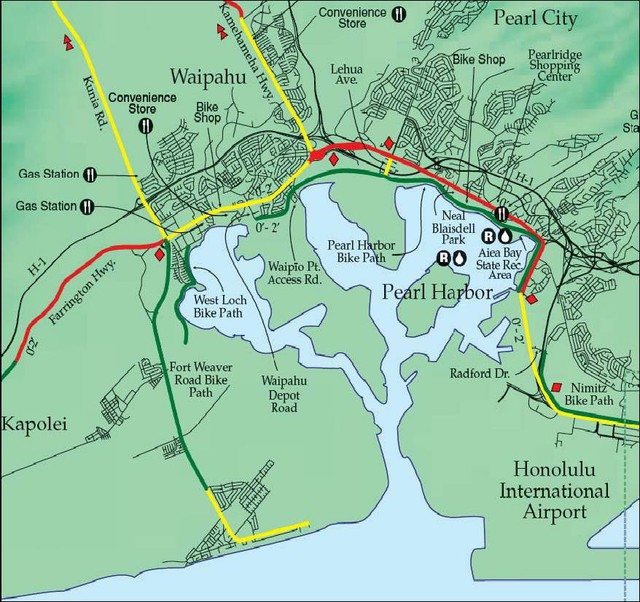
Hawaii may be known more for beaches and volcanoes than bike paths, but the state does have a paved route that gives cyclists a long, uninterrupted ride. The Pearl Harbor Historic Trail on Oahu runs about 18 miles, tracing the path of a former rail line along the shoreline from Aiea to Nanakuli. It isn’t as polished as some mainland trails, but for riders looking to combine exercise with a glimpse of local communities and views of the Pacific, it pays off.
The trail begins near Aiea, not far from Pearl Harbor. Cyclists can start at Blaisdell Park, where there is parking and access to the path. From there, the ride heads west, hugging the shoreline for long stretches. The surface is mostly asphalt, with some concrete sections, and the grade is flat from start to finish.
Cycling in Hawaii: From neighborhoods to stunning views
Scenery on the eastern end includes views of Pearl Harbor and the surrounding naval facilities. As the trail moves west, it passes through neighborhoods that reflect everyday life on Oahu, away from the resort areas. Small homes, schools, and businesses line parts of the route. The path also opens up to views of the ocean, especially around Waipahu and Ewa Beach. On clear days, the Waianae Range is visible across the water.
There are trailheads and parks along the route where riders can stop for a break. In Waipahu, the trail passes near the Hawaiian Plantation Village, a museum telling the story of the island’s sugar industry and immigrant workers. Around Kapolei, the trail skirts closer to Oahu’s expanding “second city,” where services are more available. The official route ends in Nanakuli, at least for now, as there is talk of a possible extension.
Views from a Hawaii bike trail are world-class
Because the Pearl Harbor Historic Trail runs through developed parts of the island, it feels more like a linear park than a remote escape. There are regular street crossings, and the path often runs close to neighborhoods and businesses. It’s a mix of shoreline views and urban life, which makes it distinctive but different from the isolated rail-trails many riders may know from the mainland.
There are some drawbacks to consider. The trail is not in perfect condition—some stretches are cracked or uneven. Safety concerns have been noted, especially past Waipahu, and local groups suggest using common sense about when and where to ride. Amenities such as bathrooms and water fountains are limited, so planning ahead is necessary. The tropical heat, even along the water, adds to the challenge.
Ride Hawaii style in a cool jersey!


Pearl Harbor Historic Trail
Distance: 14 miles
Hawaii may be known more for beaches and volcanoes than bike paths, but the state does have a paved route that gives cyclists a long, uninterrupted ride. The Pearl Harbor Historic Trail on Oahu runs about 18 miles, tracing the path of a former rail line along the shoreline from Aiea to Nanakuli. It isn’t as polished as some mainland trails, but for riders looking to combine exercise with a glimpse of local communities and views of the Pacific, it pays off.
The trail begins near Aiea, not far from Pearl Harbor. Cyclists can start at Blaisdell Park, where there is parking and access to the path. From there, the ride heads west, hugging the shoreline for long stretches. The surface is mostly asphalt, with some concrete sections, and the grade is flat from start to finish.
Cycling in Hawaii: From neighborhoods to stunning views
Scenery on the eastern end includes views of Pearl Harbor and the surrounding naval facilities. As the trail moves west, it passes through neighborhoods that reflect everyday life on Oahu, away from the resort areas. Small homes, schools, and businesses line parts of the route. The path also opens up to views of the ocean, especially around Waipahu and Ewa Beach. On clear days, the Waianae Range is visible across the water.
There are trailheads and parks along the route where riders can stop for a break. In Waipahu, the trail passes near the Hawaiian Plantation Village, a museum telling the story of the island’s sugar industry and immigrant workers. Around Kapolei, the trail skirts closer to Oahu’s expanding “second city,” where services are more available. The official route ends in Nanakuli, at least for now, as there is talk of a possible extension.
Views from a Hawaii bike trail are world-class
Because the Pearl Harbor Historic Trail runs through developed parts of the island, it feels more like a linear park than a remote escape. There are regular street crossings, and the path often runs close to neighborhoods and businesses. It’s a mix of shoreline views and urban life, which makes it distinctive but different from the isolated rail-trails many riders may know from the mainland.
There are some drawbacks to consider. The trail is not in perfect condition—some stretches are cracked or uneven. Safety concerns have been noted, especially past Waipahu, and local groups suggest using common sense about when and where to ride. Amenities such as bathrooms and water fountains are limited, so planning ahead is necessary. The tropical heat, even along the water, adds to the challenge.
Ride Hawaii style in a cool jersey!

Some pages contain affiliate links. If you purchase something through one of these links, we may earn a small commission.